Forex trading for beginners: how the market really works and what to learn first
You can order the same kind of articles for your own video to boost it on YouTube and Google. Just message the Telegram bot @sat_sit_bot. It writes articles around your video, embeds the video and publishes them on popular niche websites (no ads). Free trial — 50 articles.
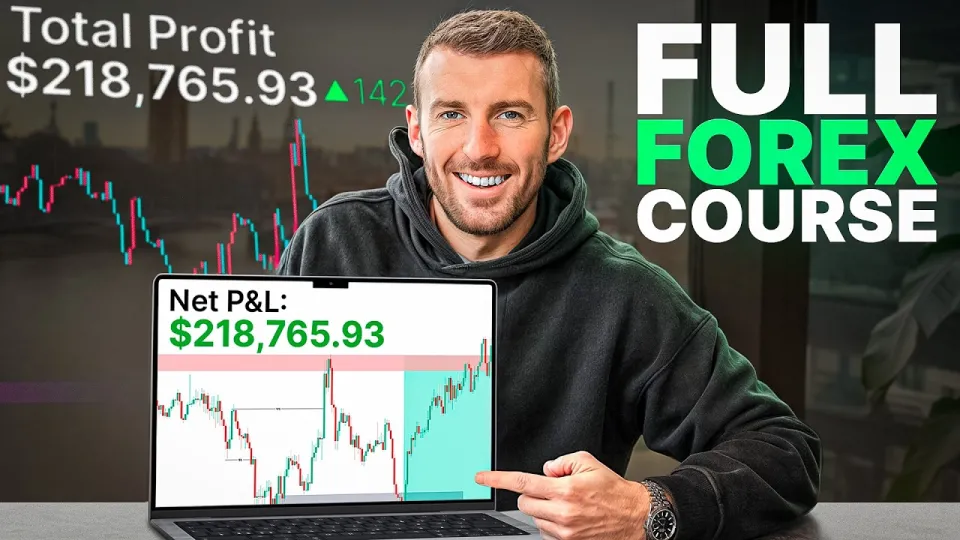
Forex trading for beginners comes down to one idea: currency prices move because buyers and sellers send orders into a market, and your job is to read that orderflow and risk a small, fixed amount when the odds favour you. Everything else — candlesticks, supply and demand zones, liquidity, psychology — is a tool for reading that flow more accurately. Matt Donlevey - Photon Trading builds his beginner guide around exactly this logic, and the free course plus cheatsheets behind it are available at the Photon Trading free training page.
The guide below is a standalone walkthrough of the same ground: what forex is, how money is actually made, which concepts matter, and how to turn them into a repeatable process you can test before risking real capital.
What forex trading actually is and who is on the other side
Forex is the market where one currency is priced in another, and every quote is a ratio between two economies. When you buy EUR/USD you are not receiving euros in your bank account — you hold a position whose value changes as the exchange rate moves. The three sessions that matter are Sydney/Tokyo, London and New York; London and the New York overlap produce the deepest liquidity and the tightest spreads, which is why most intraday strategies concentrate there.
The counterparties are not a single exchange. Currencies trade over the counter through a network of banks, brokers and liquidity providers, so there is no central tape the way there is in equities. Retail traders reach that network through a broker, and the broker's feed, spreads and execution quality become part of your edge or part of your cost.
There are three broad ways people participate: trading their own capital, trading a prop firm's capital under a funded-account model, and managing other people's money. The first two are realistic entry points for a beginner; the third requires a track record, usually a verified statement history of a year or more, and comes with regulatory obligations that vary by jurisdiction.
How money is made in forex, and what it realistically pays
Profit in forex is the difference between your entry and exit price multiplied by position size, minus costs. A 20-pip move on one standard lot (100,000 units) is roughly $200 on EUR/USD; the same move on a 0.01 lot is about $2. Position sizing, not prediction, decides whether that difference matters to your account.
Returns are usually quoted in risk units rather than percentages. A trader risking 1% per trade who earns 2R on a winner gains 2% of the account; a trader risking 5% gains 10% on the same trade but is one bad streak away from a drawdown that is hard to recover from. This is why the honest answer to "how much can I make" is: it depends on your edge, your risk per trade and how many setups your process produces per month — not on leverage.
Leverage is the most misunderstood number on the platform. 1:100 does not increase your expected return; it only lowers the margin required to hold a position, which makes oversized positions feel affordable. Most blown beginner accounts are not the result of bad analysis but of a position that was too large for the stop distance.
The market mechanics most beginners skip: spread, orderbook and auction theory
Every price you see is two prices: the bid, at which you can sell, and the ask, at which you can buy. The gap between them is the spread, and it is a cost you pay on entry — a position opens slightly in the red by exactly that amount. On majors during the London session the spread on EUR/USD is typically a fraction of a pip; on exotic pairs or during news releases it can widen several times over.
Behind the quote sits an orderbook. Market orders consume the best available liquidity and move price; limit orders sit in the book and absorb that movement. When a cluster of resting orders is swept and price then reverses, you are watching absorption — the mechanism behind most "liquidity grab" setups. Auction market theory frames the same thing from a different angle: price is a continuous auction searching for the level where buyers and sellers agree, and it accelerates through areas where they do not.
Orderflow is the practical output of all this. Instead of asking what shape a chart makes, ask who is trapped: aggressive buyers filled at a bad price, or sellers who sold into a wall of resting bids. That question produces a reason for a trade that survives being wrong, which a triangle pattern does not.
Building a strategy: structure, premium and discount, supply and demand
Market structure is the skeleton of any strategy: the sequence of higher highs and higher lows in an uptrend, lower highs and lower lows in a downtrend, and the range in between. Three structural states cover almost everything you will see — trending, ranging and transitioning — and the mistake is applying a trend entry inside a range.
Multi-timeframe analysis turns structure into a filter. Read the higher timeframe for direction, the middle one for the zone, and the lowest one only for the trigger. Premium and discount add a price filter: in an uptrend, buying in the discount half of the recent range gives a better stop distance than buying at the high, and the same logic inverted applies to shorts. Supply and demand zones are simply the areas where the previous imbalance started, and they matter because unfilled orders tend to remain there.
A complete setup therefore looks like this:
- Higher-timeframe bias: trend direction or range boundaries.
- Zone: a supply or demand area, ideally in premium or discount relative to the dealing range.
- Liquidity: a recent high or low that likely holds resting stops, which price may sweep before continuing.
- Trigger: a lower-timeframe confirmation inside the zone, with a defined invalidation point.
- Risk: a fixed percentage of the account, with the stop placed by structure rather than by comfort.
Risk, trade management and the three mistakes that cost the most
Trade management starts before entry: stop distance and position size are set together, and the stop belongs where the idea is proven wrong, not where the loss feels acceptable. Common management choices are a fixed reward-to-risk target, partial exits at a structural level, or trailing behind new swing points — but the rule has to be written down before the trade, because decisions made mid-trade are usually emotional.
Money management is the part that keeps you in the game. A practical framework for a beginner: risk 0.5–1% per trade, cap total open risk across correlated pairs, and define a daily and weekly loss limit that stops trading rather than inviting revenge entries. Correlation matters here — long EUR/USD and long GBP/USD are largely the same bet on a weak dollar.
The three mistakes that show up again and again:
- Oversizing. A correct analysis with a position five times too large still ends in a margin call.
- No written plan. Without predefined entry, exit and risk rules, every trade becomes a fresh debate.
- No journal. If you cannot measure which setup, session and pair produce your results, you cannot improve, only repeat.
Questions beginners actually ask
A recurring theme in the comments under long-form beginner courses is speed and density: three hours of material is a lot to absorb in one sitting, and non-native speakers often find the pace hard. The fix is structural — watch one topic, then backtest it on a demo account before moving on, rather than trying to hold the entire curriculum in your head at once.
Another common doubt is whether free material can be worth anything when similar guides are sold. The honest test is not the price but the testability: if a concept can be written as a rule, backtested over a few hundred trades and journaled, it can be evaluated; if it only produces screenshots, it cannot.
Experienced traders also raise a fair point about psychology: it is usually taught too early. Discipline is much easier to build once a strategy has a measurable edge, because then following the rules has a payoff you have already seen in your own data. Before that, "psychology" is often just frustration with an untested method.
A practical starting sequence
- Open a demo account with a broker whose regulation and costs you have actually checked — spread, commission and swap, not just the headline spread.
- Pick one pair (EUR/USD is the standard choice) and one session.
- Write a one-page trade plan: bias, zone, trigger, stop, target, risk per trade, daily loss limit.
- Backtest at least 100 setups by hand and log every one.
- Trade the plan on demo for a month, then review the journal weekly before adding size.
Useful links
- Free Photon Trading course and cheatsheets: https://www.photontradingfx.com/free-training?el=beginnersguide&htrafficsource=YT
- Photon Trading mentorship: https://www.photontradingfx.com?el=beginnersguide&htrafficsource=yt
- Free Telegram channel with analysis and trade recaps: https://t.me/photontrading
- Instagram: https://www.instagram.com/photontrading/
The bottom line on learning forex
Forex rewards traders who understand the machinery — orderflow, spread, liquidity — and then apply a small, repeatable risk on top of it. The concepts in this guide are not secret; the difference between traders who last and those who do not is a written plan, a tested edge and a journal that tells the truth. Matt Donlevey - Photon Trading structures his beginner material around exactly that progression, from market microstructure to a full trade plan, and the free course and cheatsheets are the natural next step if you want the full walkthrough. Start on demo, measure everything, and only increase risk when your own records justify it.
Key takeaways
- Forex is an over-the-counter market where currencies are quoted in pairs; profit comes from the difference between entry and exit price, not from owning the currency.
- Price moves because of orderflow — market and limit orders hitting bid and ask — not because of chart shapes.
- The spread is the broker's markup between bid and ask and is a real cost on every trade, alongside commission and swap.
- A working plan needs four parts: market structure, entry trigger, risk per trade and a written journal.
- Most beginner losses come from oversized risk, trading without a tested plan and skipping the journal.
Source: Beginners Guide To Forex Trading In 2026 (+3 hours) · Markdown version
Questions & answers
How much money do I need to start trading forex?
You can open a demo account for free and learn the mechanics without capital, and many brokers allow live accounts from $100–$500. What matters more than the minimum deposit is that your risk per trade (0.5–1%) is large enough to be meaningful but small enough that a losing streak does not end your account.
Is technical analysis useless, as some traders claim?
Chart patterns alone do not explain why price moves, which is the fair criticism. Technical analysis becomes useful when it is tied to market mechanics: where orders rest, where liquidity sits, and whether price is in premium or discount relative to the recent range.
Should I study trading psychology before or after building a strategy?
Build and test the strategy first. Discipline is far easier once you have your own backtest and journal data showing that following the rules pays, because then the rules are evidence-based rather than abstract advice.
How long does it take to become consistently profitable?
There is no fixed timeline, but a realistic path is several months of study and backtesting followed by months of demo or small live trading with a journal. Progress is measured by rule adherence and a stable risk profile, not by a single profitable week.